
Hip Pain After Car Accident: Complete Brampton Recovery Guide
Hip pain after car accident is one of the most common injuries treated at DRS Physio & Wellness in Brampton. Patients often report hip stiffness after accident, difficulty walking, reduced mobility, and deep joint discomfort. Because the hip is a major weight‑bearing structure, even minor collision forces can lead to hip sprain car accident injuries, hip strain, tendon irritation, or nerve compression. Understanding how hip injuries develop — and how to treat them — is essential for safe, insurer‑friendly recovery.
Symptoms of Hip Pain After Car Accident
Hip pain after car accident may present with:
Sharp or aching hip joint pain accident
Pain radiating into the groin or thigh
Difficulty weight‑bearing or standing
Hip stiffness after accident
Clicking, catching, or instability
Numbness or tingling down the leg
Bruising or swelling around the hip
Pain when sitting, climbing stairs, or bending
These symptoms often require structured hip rehabilitation Brampton programs to prevent chronic pain.
Causes of Hip Pain After Car Accident
Common causes include:
Direct impact to the hip or pelvis
Seatbelt compression forces
Sudden twisting during collision
Airbag deployment trauma
Hip ligament injury
Hip tendon injury
Muscle contusions
Joint capsule irritation
Pelvic alignment changes
Nerve compression
These injuries frequently appear in Motor Vehicle Accident (MVA) rehab Brampton cases and require insurer‑friendly documentation.
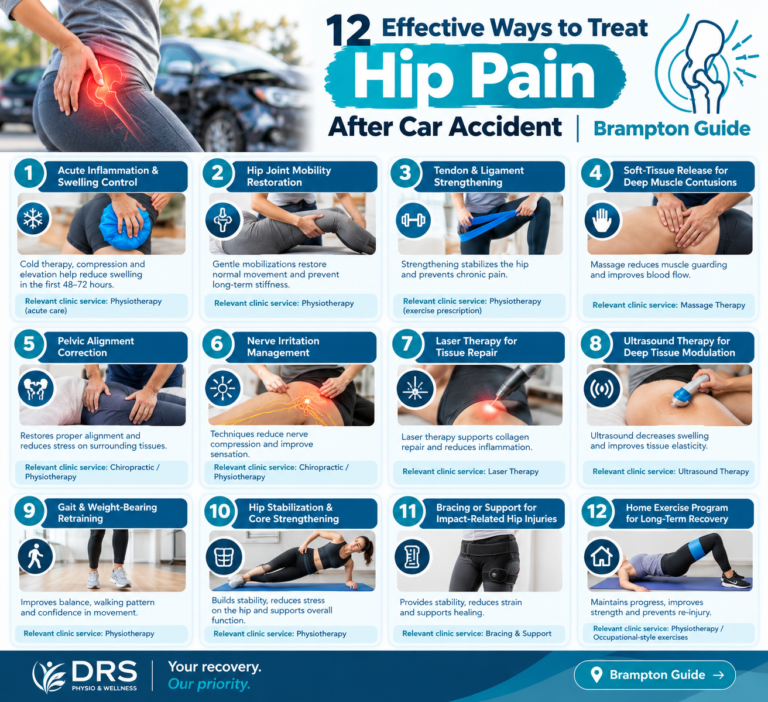
12 Effective Ways to Treat Hip Pain After Car Accident for Brampton Patients
1. Acute Inflammation & Swelling Control
Cold therapy, compression, and elevation reduce early swelling and pain. Relevant clinic service: Physiotherapy (acute care)
2. Hip Joint Mobility Restoration
Gentle mobilizations restore movement and prevent long‑term stiffness. Relevant clinic service: Chiropractor or Physio
3. Tendon & Ligament Strengthening
Targeted strengthening stabilizes the hip and reduces chronic pain risk. Relevant clinic service: Chiropractic or Physiotherapy (exercise prescription)
4. Soft‑Tissue Release for Deep Muscle Contusions
Massage therapy improves circulation and reduces muscle guarding. Relevant clinic service: Massage Therapy
5. Pelvic Alignment Correction
Chiropractic adjustments help restore proper pelvic and hip alignment. Relevant clinic service: Chiropractic
6. Nerve Irritation Management
Techniques reduce nerve compression and improve sensation down the leg. Relevant clinic service: Chiropractic / Physiotherapy
7. Laser Therapy for Tissue Repair
Laser therapy accelerates healing of strained ligaments and tendons. Relevant clinic service: Laser Therapy
8. Ultrasound Therapy for Deep Tissue Modulation
Ultrasound reduces inflammation and improves tissue elasticity. Relevant clinic service: Ultrasound Therapy
9. Gait & Weight‑Bearing Retraining
Correcting walking patterns prevents reinjury and improves hip stability. Relevant clinic service: Physiotherapy / Chiropractic
10. Hip Stabilization & Core Strengthening
Strengthening surrounding muscles reduces pressure on the hip joint. Relevant clinic service: Physiotherapy
11. Bracing or Support for Impact‑Related Hip Injuries
Temporary support reduces strain during early recovery. Relevant clinic service: Bracing & Support
12. Home Exercise Program for Long‑Term Recovery
A structured home program prevents stiffness and improves functional mobility. Relevant clinic service: Physiotherapy / Chiropractic
Treatment Overview
Hip pain after car accident requires a structured rehabilitation plan that includes mobility restoration, strength building, soft‑tissue healing, gait retraining, and insurer‑friendly documentation. At DRS Physio & Wellness, clinicians create personalized treatment plans based on your injury severity, functional limitations, and insurance coverage.
Rehab Programs for Hip Pain After Car Accident
Motor Vehicle Accident Rehab — insurer‑friendly treatment
Chronic Pain Program — long‑term recovery
Mobile Therapy — in‑home treatment
Evidence-Based Resources for Hip Pain After Car Accident
To support medical accuracy and provide readers with reliable information about hip injuries, soft-tissue trauma, fractures, diagnosis, imaging, and Ontario accident benefits, the following resources from recognized medical and regulatory organizations are recommended.
Mayo Clinic — Hip Pain
Mayo Clinic provides information about common causes of hip pain, including injuries such as hip fractures, dislocations, labral tears, sprains, strains, and tendinitis. It also discusses symptoms and situations where medical evaluation may be necessary.
Cleveland Clinic — Hip Pain: Causes and Treatment
Cleveland Clinic — Hip Pain: Causes and Treatment
Cleveland Clinic explains how trauma, including motor vehicle accidents, can cause hip pain and discusses injuries such as muscle strains, labral tears, fractures, and hip dislocations. The resource also provides information about diagnosis and treatment.
American Academy of Orthopaedic Surgeons — Hip Strains
The American Academy of Orthopaedic Surgeons explains hip muscle and tendon strains, including symptoms, physical examination, imaging, home care, physical therapy, and rehabilitation. It is particularly relevant to the soft-tissue injury component of hip pain after trauma.
American Academy of Orthopaedic Surgeons — Hip Fractures
AAOS OrthoInfo — Hip Fractures
AAOS provides information about hip fractures, including fractures caused by high-energy trauma such as motor vehicle collisions, as well as diagnosis, imaging, and treatment.
American College of Radiology — Acute Hip Pain
ACR Appropriateness Criteria — Acute Hip Pain
The American College of Radiology provides evidence-based guidance for evaluating acute traumatic hip pain. Its recommendations address initial imaging and situations involving suspected fractures or tendon, muscle, and ligament injuries when initial radiographs are negative or inconclusive.
Ontario — Statutory Accident Benefits Schedule
Ontario e-Laws — Statutory Accident Benefits Schedule (O. Reg. 34/10)
Ontario’s Statutory Accident Benefits Schedule establishes the legislative framework for accident benefits following eligible motor vehicle accidents in Ontario, including medical and rehabilitation benefits.
Financial Services Regulatory Authority of Ontario — After an Accident
FSRA — After an Accident: Understanding the Claims Process
FSRA provides consumer information about Ontario’s accident-benefits and auto-insurance claims process. For policies entered into on or after July 1, 2026, medical, rehabilitation, and attendant-care benefits remain mandatory, while certain other accident benefits are optional.
Financial Services Regulatory Authority of Ontario — Accident Benefits Coverage
FSRA — Customize Your Liability and Accident Benefits Coverage
This FSRA resource explains standard and optional accident-benefit coverage in Ontario, including medical, rehabilitation, and attendant-care benefits that may apply following an automobile accident.
Recovery Timeline
Week 1–2: Swelling reduction, pain control
Week 3–6: Mobility restoration, strengthening
Week 6–12: Gait retraining, functional recovery
3+ months: Chronic pain prevention, long‑term stability
Book Your Car Accident Injury Appointment
If you’re experiencing hip pain after car accident, our Brampton clinic provides safe, effective, and personalized care — whether you’re dealing with impact‑related pain, inflammation, stiffness, nerve irritation, or mobility limitations affecting your daily movement.
Explore all our services at DRS Physio & Wellness or book your car accident injury appointment today through WhatsApp.
If you don’t use WhatsApp, send us a TEXT — we’re available 24/7 for SMS chat.
In‑Home Appointments: Prefer mobile care? Book in‑home car accident injury treatment at DRS Mobile Therapy
Need Legal Support After Your Accident? If your pain is related to a motor vehicle accident claim and you need help with legal guidance, documentation, or next steps, visit our Personal Injury Legal Support page.

Haninder Dhillon
Co-Owner & Co-Founder
DRS Physio & Wellness | DRS Mobile Therapy
1090 Peter Robertson Blvd Unit 105
Brampton, ON L6R 3B3
Pingback: Lower Back and Hip Pain Treatment Brampton | Patient Recovery Story