Concussion Symptoms After Car Accident: Learn Symptoms & Recovery Strategies
Experiencing concussion symptoms after car accident events is extremely common, especially in Brampton where rear‑end collisions and intersection impacts happen frequently. Many patients feel “fine” immediately after the crash, only to develop headaches, dizziness, or confusion hours later. This guide explains the most important concussion symptoms after car accident injuries, how they develop, and when to seek care.
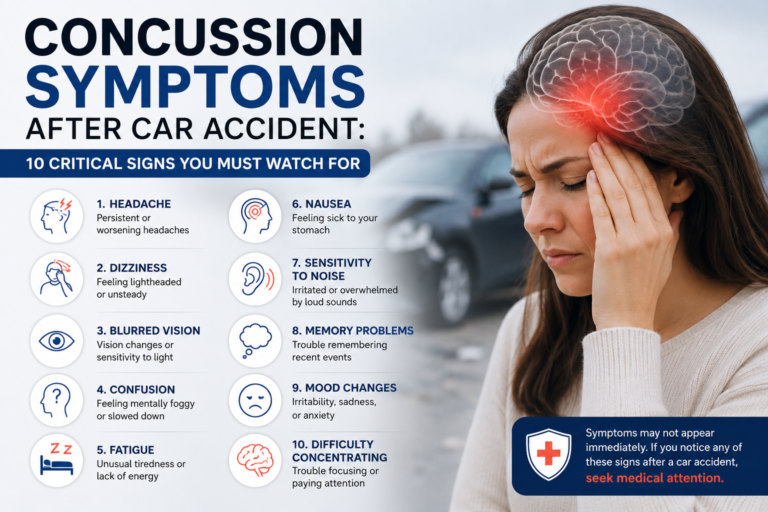
10 Critical Signs You Must Watch For After a Car Accident
Below are the 10 critical signs that may indicate a concussion after a collision. These are general educational indicators — if you experience any of them, consult a qualified healthcare professional.
1. Persistent Headache or Pressure
One of the most common concussion symptoms after car accident injuries is a headache that worsens over time.
2. Dizziness or Balance Problems
Vestibular dysfunction is extremely common after whiplash and head acceleration injuries.
3. Nausea or Vomiting
This may appear immediately or several hours after the collision.
4. Sensitivity to Light or Sound
Bright lights, screens, or loud environments may worsen symptoms.
5. Blurred or Double Vision
Visual disturbances are a key secondary keyword and a major concussion indicator.
6. Difficulty Concentrating
Feeling “foggy,” slowed down, or mentally fatigued is common.
7. Memory Problems
Trouble recalling events before or after the accident is a red flag.
8. Irritability or Mood Changes
Emotional changes often accompany post‑concussion symptoms.
9. Sleep Disturbances
Sleeping too much, too little, or feeling unrested are common issues.
10. Delayed Symptoms
Many concussion symptoms after car accident injuries appear 24–72 hours later.
For authoritative medical information, see the CDC Concussion Overview
Why Concussion Symptoms Often Appear Later
Delayed concussion symptoms after car accident injuries happen because:
adrenaline masks early symptoms
swelling develops over time
neck injuries (whiplash) mimic concussion symptoms
visual and vestibular issues worsen gradually
This is why early assessment is important.
How Physiotherapy Helps Concussion Recovery in Brampton
Vestibular Rehabilitation
Improves dizziness, balance, and motion sensitivity.
Cervical Spine Treatment
Many concussion symptoms after car accident injuries overlap with whiplash — treating the neck reduces headaches and dizziness.
Visual Rehabilitation
Helps with eye tracking, focus, and visual fatigue.
Graded Exercise Therapy
Light aerobic activity improves blood flow and speeds recovery.
Return‑to‑Work Planning
Your physiotherapist provides safe, structured guidance.
FSRA Accident Benefits for Concussion Treatment (Ontario)
If your concussion occurred during a motor vehicle accident, you may qualify for:
Physiotherapy
Chiropractic care
Massage therapy
Occupational therapy
Psychological therapy
In‑home treatment
OCF‑3 and OCF‑18 support
Official FSRA resource (external link)
Related Knowledge Base: Car Accident Injury Education
Understanding concussion symptoms after car accident events is easier when you explore how other collision‑related injuries behave. These internal resources help Brampton patients learn about common post‑accident conditions, FSRA coverage, and recovery timelines.
Whiplash Symptoms After Car Accident
Whiplash often occurs alongside concussions because both injuries involve rapid head acceleration. Many patients experience overlapping symptoms such as headaches, dizziness, and neck stiffness. Reviewing whiplash patterns helps you understand why concussion symptoms may worsen when the cervical spine is also injured.
Car Accident Injury Treatment Brampton
This resource explains how Brampton clinics assess and treat collision‑related injuries, including concussions, whiplash, back pain, and soft‑tissue trauma. It outlines what happens during your first visit, how FSRA accident benefits work, and what documentation (OCF‑3, OCF‑18) is required.
In‑Home Car Accident Injury Treatment
Some patients with concussion symptoms after a car accident experience dizziness, fatigue, or sensitivity to light that makes clinic visits difficult. This guide explains how mobile physiotherapy works, how assessments are performed at home, and how FSRA covers in‑home rehabilitation services.
FSRA Accident Benefits
Learn how Ontario’s FSRA system supports concussion recovery after a collision. This knowledge base entry explains medical/rehab benefits, treatment plan approvals, and how your clinic submits OCF forms to ensure your care is funded.
OCF Forms Ontario
Concussion cases often require OCF‑3 (Disability Certificate) and OCF‑18 (Treatment Plan). This internal resource breaks down each form, what information is needed, and how your clinic handles insurer communication on your behalf.
Book Your Car Accident Injury Appointment
If you’re looking for a car accident injury treatment Brampton clinic that provides safe, effective, and personalized care, our team is ready to help you recover, move better, and feel better — whether you’re dealing with concussion symptoms after car accident, headaches, dizziness, visual changes, or post‑concussion soft‑tissue injuries.
Explore all our services at DRS Physio & Wellness or book your car accident injury appointment today through WhatsApp.
If you don’t use WhatsApp, send us a TEXT — we’re available 24/7 for SMS chat.
In‑Home Appointments: Prefer mobile care? Book in‑home car accident injury treatment at DRS Mobile Therapy
Need Legal Support After Your Accident? If your concussion symptoms are related to a motor vehicle accident claim and you need help with legal guidance, documentation, or next steps, visit our Personal Injury Legal Support page.
Haninder Dhillon
Co-Owner & Co-Founder
DRS Physio & Wellness | DRS Mobile Therapy
1090 Peter Robertson Blvd Unit 105
Brampton, ON L6R 3B3